Executive summary
China and India hold the first and third largest share of global gross domestic product (GDP) at purchasing power parity (PPP) – and have led the broader shift in global economic power towards emerging market and developing economies (EMDEs). India is growing rapidly, and is projected to reduce its share gap with the United States (US), the second largest contributor to global GDP (PPP), to just 3.5 percentage points within 5 years.1
Rural India accounts for 46% of India’s GDP,2 and receives an estimated USD 36–48 billion (2024) in domestic remittances3 as well as a share of international remittances (USD 151 billion in 2025) – of which India has been the world’s largest recipient over the past 2 decades.4 It is also home to 64% of India’s population,5 and bears 77% of its recorded deaths due to non-communicable diseases (NCDs).6 Yet, rural India remains a large market that innovative medical companies do not research and reach well.
Rural India
accounts for
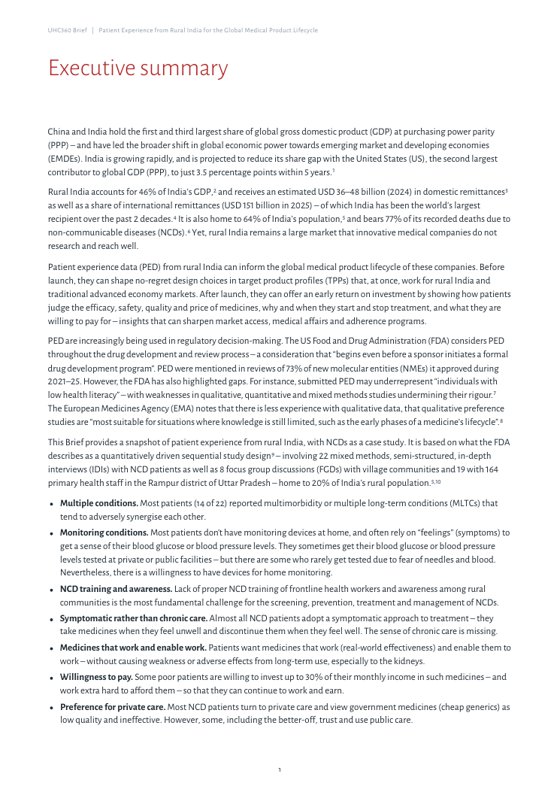
Patient experience data (PED) from rural India can inform the global medical product lifecycle of these companies. Before launch, they can shape no-regret design choices in target product profiles (TPPs) that, at once, work for rural India and traditional advanced economy markets. After launch, they can offer an early return on investment by showing how patients judge the efficacy, safety, quality and price of medicines, why and when they start and stop treatment, and what they are willing to pay for – insights that can sharpen market access, medical affairs and adherence programs.
PED are increasingly being used in regulatory decision-making. The US Food and Drug Administration (FDA) considers PED throughout the drug development and review process – a consideration that “begins even before a sponsor initiates a formal drug development program”. PED were mentioned in reviews of 73% of new molecular entities (NMEs) it approved during 2021–25. However, the FDA has also highlighted gaps. For instance, submitted PED may underrepresent “individuals with low health literacy” – with weaknesses in qualitative, quantitative and mixed methods studies undermining their rigour.7 The European Medicines Agency (EMA) notes that there is less experience with qualitative data, that qualitative preference studies are “most suitable for situations where knowledge is still limited, such as the early phases of a medicine’s lifecycle”.8
This Brief provides a snapshot of patient experience from rural India, with NCDs as a case study. It is based on what the FDA describes as a quantitatively driven sequential study design9 – involving 22 mixed methods, semi-structured, in-depth interviews (IDIs) with NCD patients as well as 8 focus group discussions (FGDs) with village communities and 19 with 164 primary health staff in the Rampur district of Uttar Pradesh – home to 20% of India’s rural population.5,10
- Multiple conditions. Most patients (14 of 22) reported multimorbidity or multiple long-term conditions (MLTCs) that tend to adversely synergise each other.
- Monitoring conditions. Most patients don’t have monitoring devices at home, and often rely on “feelings” (symptoms) to get a sense of their blood glucose or blood pressure levels. They sometimes get their blood glucose or blood pressure levels tested at private or public facilities – but there are some who rarely get tested due to fear of needles and blood. Nevertheless, there is a willingness to have devices for home monitoring.
- NCD training and awareness. Lack of proper NCD training of frontline health workers and awareness among rural communities is the most fundamental challenge for the screening, prevention, treatment and management of NCDs.
- Symptomatic rather than chronic care. Almost all NCD patients adopt a symptomatic approach to treatment – they take medicines when they feel unwell and discontinue them when they feel well. The sense of chronic care is missing.
- Medicines that work and enable work. Patients want medicines that work (real-world effectiveness) and enable them to work – without causing weakness or adverse effects from long-term use, especially to the kidneys.
- Willingness to pay. Some poor patients are willing to invest up to 30% of their monthly income in such medicines – and work extra hard to afford them – so that they can continue to work and earn.
- Preference for private care. Most NCD patients turn to private care and view government medicines (cheap generics) as low quality and ineffective. However, some, including the better-off, trust and use public care.
Why PERI matters
An economic, epidemiological and demographic snapshot
1st
Population (1.5 billion) and international remittances received (USD 151 billion) (2025)4
2nd
Burden of non-communicable diseases (NCDs) in terms of prevalence, deaths and disability-adjusted life years (DALYs) (2023)11
3rd
Share of global gross domestic product (GDP) at purchasing power parity (PPP) since 20091
719 million
Population aged 30 years and above to be screened for NCDs by primary health staff (2026)5
909 million
People – more than the combined populations of the United States (US), Indonesia and Pakistan (2025)5,12
46%
Share of India’s GDP (2019–20)2
USD 36–48 bn
Domestic remittances received (2024)3
77%
Share of NCD deaths in India (as recorded by the Sample Registration System, 2022–24)6
20%
Share of rural India living in Uttar Pradesh (UP) (2025)5
107 million
Population aged 30 years and above to be screened for NCDs by primary health staff (2026)5
6th
Largest burden of NCD DALYs in the world – marginally lower than Russia’s, but much higher than Pakistan’s (2023)11
8th
Largest burden of NCD deaths in the world – marginally lower than Brazil’s (2023)11
5–18%
NCD service coverage across UP’s 75 districts (2019–21)13
75%
Households in UP that do not generally use government health facilities (2019–21)14
66%
Out-of-pocket share of total health expenditure – the highest in India (2022–23)15
Patient experience from a regulatory perspective
What US, European and international regulators say about patient experience data
Milestones in this chapter
- 1998ICH E5 guideline on ethnic factors
- 2012FDA pioneers PFDD meetings
- 201621st Century Cures Act, Sections 3001–3002
- 2020–254 FDA PFDD guidance documents
- 2025EMA draft reflection paper on PED; ICH draft E22 guideline
- 2026FDA assessment of PED in regulatory decision-making
Regulators in the US and Europe have been making efforts “to steer medicine development towards programmes that not only meet the requirements for quality, safety and efficacy of individual products, but also incorporate the broader perspectives of patients and carers”.8 According to the US Food and Drug Administration (FDA), patients “are experts on what it is like to live with the condition”, and are “in a unique position to contribute to an understanding of benefit and risk considerations throughout the medical product development process”.16 The European Medicines Agency (EMA) argues that “patients may value different aspects of their disease and available treatments than medicine developers”, and “an optimal patient-relevant medicine development programme incorporates patients’ perspectives and documents their experience”.8
United States
The FDA’s focus on Patient-Focused Drug Development (PFDD) goes back to 2012, when it pioneered PFDD meetings as “a systematic approach to help ensure that patients’ experiences, perspectives, needs, and priorities are captured and meaningfully incorporated into drug development and evaluation”.17 In subsequent years, more clarity was provided in the US on the meaning of patient experience data (PED) and methods for their collection.
Section 3001 of the 21st Century Cures Act, 2016 outlined that PED are “intended to provide information about patients’ experiences with a disease or condition, including—(A) the impact of such disease or condition, or a related therapy, on patients’ lives; and (B) patient preferences with respect to treatment of such disease or condition”. Section 3002 required the FDA to develop guidance documents for the collection of PED and their use in drug development.18
The FDA issued 4 PFDD guidance documents between 2020 and 2025; Guidance 4 is still a draft.19 Guidance 1 (2020) included “the signs and symptoms patients experience” and how they “affect their day-to-day functioning and quality of life” within the ambit of PED. It also noted that “qualitative, quantitative, or mixed methods may be appropriate for collection of” PED. Guidance 2 (2022) set out best practices in qualitative research, noting that “focus groups could be used in preliminary research to explore a broad topic followed by one-on-one interviews to obtain more detailed information on the topic of interest”, and described quantitatively and qualitatively driven sequential and concurrent mixed methods designs. Guidance 3 (2025) helps sponsors select, develop or modify “fit-for-purpose” clinical outcome assessments (COAs) – measures of how patients feel or function. It notes that where a concept closely reflects patients’ daily lived experience, “patients’ input regarding the items/setup/tasks (e.g., through qualitative studies) is important”. Study samples should “reflect the clinical characteristics and demographics of the target patient population”, and include “reporters who reflect the range of literacy and numeracy in the target population”.19
A 2026 assessment – based on focus group discussions (FGDs) with FDA staff and a review of 800 drug and biologic submissions approved between February 2021 and December 2025 – found that “FDA reviewers consider and use patient experience data throughout drug development and the review process”, and that “FDA’s consideration of patient experience data begins even before a sponsor initiates a formal drug development program”. PED are “evaluated in support of regulatory decisions, including benefit-risk determinations and labeling claims”.7
According to the assessment, “early stage discussions of patient experience data with FDA include conversations about the appropriateness of planned qualitative research methods, how patient experience data will inform the sponsor’s target product profile, and early endpoint planning including the feasibility of collecting data in the intended population (e.g., patient preference studies which can inform endpoint selection or hierarchy…)”. PED also “informs discussions about which concepts to target for measurement, such as symptoms, functioning, and health-related quality of life, and whether those concepts are salient and meaningful to patients”. It “further informs discussions about clinical trial design and conduct”, including dosing regimens, routes of administration and the burden that trials place on patients.7
PED were mentioned in reviews of 73% of new molecular entities (NMEs) the FDA approved during 2021–25 – up from 68% in the 2021 assessment, rising from 69% in 2021 to 85% in 2025. Most PED came from the sponsors themselves. The assessment also found that weaknesses such as “unclear saturation methods, inadequate sample sizes, and weak psychometric properties” reduce the rigour of sponsor-submitted data, and that PED may underrepresent “individuals with low health literacy, limiting the generalizability of findings”.7
Europe
The EMA’s draft reflection paper on PED (2025) defines them as data that “directly reflect the experience of a patient or carer, without input or interpretation by a healthcare professional, third party or (artificial intelligence [AI]-based) device”. Patient experience can include “health and functional status, disease symptoms, disease course, treatment preferences, QoL [quality of life], factors impacting treatment adherence, treatment outcomes and side effects”. It can be collected through quantitative methods, such as patient-reported outcome measures (PROMs); “qualitative methods (e.g., interviews, focus groups or qualitative surveys that reflect the wider perspective of patients’ experience)”; or mixed methods. Key points from the paper include:8
- Lifecycle approach. PED “should be systematically considered for informing medicines development from the earliest stages (including non-clinical stages) through to post marketing”, and can also inform health technology assessment (HTA), pricing and reimbursement. Stakeholders “are therefore encouraged to embed PED across all stages of medicine development”.
- Key gaps. PED “are not systematically included in all aspects of medicine development”. While patient-reported outcomes (PROs) “have already been accepted as efficacy endpoints for clinical trials, there is less experience with other PED types such as patient preferences or with qualitative data from patient engagement activities”.
- Early qualitative data. Early patient engagement by medicines developers in research and development “can contribute to establishing the right research questions, providing insights into patients’ preferred outcomes and selection of appropriate measures (such as PROs), medicine characteristics and their views on the balance between risks and benefits”. Qualitative preference studies are “most suitable for situations where knowledge is still limited, such as the early phases of a medicine’s lifecycle”.
- Representativeness. Patients’ perceptions of disease burden and treatment preferences “may differ across geographical areas” – and PED representativeness can be improved “by involving a wider range of patients, using varied methods of data collection”.
- Early advice. Existing guidelines on PED in the European Union (EU) are “either fragmented or outdated”, which “creates uncertainties for medicines developers”, and the reflection paper itself “does not include detailed methodological guidance”. The EMA, therefore, encourages developers to seek its scientific advice on PED at the earliest possible stage, preferably jointly with HTA bodies.
International Council for Harmonisation (ICH)
The ICH’s draft E22 guideline on patient preference studies (2025) notes that qualitative preference studies “may be useful, for example, in the form of interviews, to identify which attributes are important to patients”, and that studies conducted in other regions “may inform regulatory drug assessment and related decisions in the local region”, provided applicants offer a justification.20 Its E5 guideline (1998) recognises “extrinsic” ethnic factors, “associated with the environment and culture in which a person resides”, including “medical practice, diet”, “socioeconomic status” and “compliance with prescribed medications”.21
Study design and methods
Focus groups and mixed methods, semi-structured, in-depth interviews
Rampur, Uttar Pradesh
22 patient interviews
8 village FGDs
19 FGDs with 164 primary health staff
To begin with, UHC360 is collecting PED from NCD patients in the rural areas of UP’s Rampur district – where it is also supporting the public primary health system (PPHS) for robust collection and analysis of NCD data. PPHS staff are supposed to collect data on metabolic, behavioural and environmental risks and symptoms as well as screen all adults aged 30 years and above – 719 million in India, 107 million in UP – for common NCDs.5
We began with UP as it is home to 20% of India’s rural population, and has the world’s 6th highest burden of NCD DALYs and 8th highest burden of NCD deaths. Rampur was chosen because it had the 5th lowest literacy rate (53%)22 in UP, and a lower NCD service coverage (8%)13 than the 4 districts with a lower literacy rate. There is enormous unmet need for NCD care as well as willingness to pay.
Following FDA Guidance 2 – that “focus groups could be used in preliminary research to explore a broad topic followed by one-on-one interviews to obtain more detailed information on the topic of interest”9 – we began with 8 FGDs (February to April 2026) with village communities to explore their broad perspectives on the local prevalence and determinants of NCDs as well as their treatment pathways, preferences and challenges. Since April 2026, we have interviewed 22 NCD patients (Exhibit 2), and conducted 19 FGDs with 164 primary health staff for baseline evaluation of NCD data collection by the PPHS.23 All field research was led by the author, who has 21 years of experience in mixed methods research, and recently led an endline evaluation of a primary health intervention, implemented by the Johns Hopkins University with its partner institutions in rural Gujarat, India.
PED interviews
Interviews took place in Rampur’s Swar and Saidnagar blocks – 6 at a brick kiln, whose owner mobilised respondents from nearby villages through his staff, and the rest at PPHS facilities, where staff either called in NCD patients who lived nearby or asked doctors to send visiting NCD patients to a room set aside for the interviews. PPHS facilities served mainly as venues: some of those interviewed there were not receiving any treatment; some were being treated privately, and others at the PPHS. Thanks to their regular household visits, frontline health workers (FHWs) tend to know NCD patients in their respective areas. During our recent visit (31 October to 3 November 2026), we also interviewed the owners of a private radiology centre, a private pharmacy and a Janaushadhi Kendra – a government-supported, privately owned pharmacy for highly affordable generics.
Others were present during most of the interviews, but this did not appear to affect their responses. At PPHS facilities, respondents were able to talk openly about the challenges in their services – an FHW even said that she seeks private care because medicines in the PPHS are not effective. Even at the brick kiln, respondents openly discussed the impact of NCDs on their ability to work and earn in front of the owner. PPHS staff, too, have been forthcoming about their challenges and weaknesses.
Verbal consent was sought from the respondents in Hindi, UP’s and the author’s native language. Only the FGDs with village communities were audio-recorded; handwritten notes were taken in all other cases. Health conditions reported during patient interviews were coded according to the World Health Organization’s (WHO) International Classification of Diseases, 11th Revision (ICD-11) (Exhibit 2).24
Interview tool
Given repeated references to mental health problems during village FGDs, we decided to use the self-translated Hindi version of the World Health Organization-Five Well-Being Index (WHO-5) for structured questions during our first 6 patient interviews.25 Since family emerged as a major driver of well-being in these interviews, we started searching the literature for other relevant tools for the structured component of our future interviews. Realising that none of the existing tools could be used in their current form in our context, we decided to select and adapt questions from some of them. We developed a tool that we piloted for 9 patient interviews in July 2026 – and whose revised version we used for the remaining 7 interviews during our recent visit.
It is a mixed methods, semi-structured tool, designed to build rich patient experience narratives, following what the FDA describes as a quantitatively driven sequential design.9 It begins with structured questions that cover patients’ medical profile (diseases, treatment, willingness to pay, functional and financial impact), social determinants of health, life satisfaction, overall, mental, social and family well-being. Several of these questions were adapted for our context from the WHO-5, the WHO World Health Survey Plus and the Hong Kong Family Wellbeing Index.25–27 A semi-structured IDI then explores potential interconnections between their responses and elicits other information that patients consider important.
Why a semi-structured tool?
Our field research in rural India since 2009 suggests that semi-structured interviews work best in that context: the researcher has to let respondent narratives emerge rather than follow or complete a questionnaire rigidly, with the focus being on the narrative (substance) rather than the tool. Our interviews in rural Rampur bore this out: patients often answered rating questions in words rather than numbers, and the richest material came from the IDI section. This is consistent with the EMA’s draft reflection paper, which sees qualitative input as most suitable where knowledge is still limited (Chapter 2).
Limitations
Our field research has so far been exploratory and based on convenience rather than purposive sampling. Our findings should, therefore, not be seen as comprehensive or representative in any way. Their aim, in any case, was to provide a snapshot of patient experience from rural India and illustrate its value for the global medical product lifecycle.
PERI for the global medical product lifecycle
Self, society and systems in patients’ treatment decisions
Both the FDA and the EMA see a role for PED across the medical product lifecycle (Chapter 2). Given the growing shift in global economic power towards emerging market and developing economies (EMDEs) like India, that lifecycle needs to be increasingly global, from the design phase itself, for research-based, patient-centric companies in particular. Before launch, PED from EMDE contexts like rural India can help shape no-regret design choices for products that work, at once, for EMDE and traditional advanced economy contexts. An example is GE Healthcare’s handheld electrocardiogram (ECG) device, which was developed with rural India in view, but sold in the US as well.28 After launch, such PED can offer an early return on investment by showing how patients judge the efficacy, safety, quality and price of medicines, why and when they start and stop treatment, and what they are willing to pay for – insights that can sharpen market access, medical affairs and adherence programs.
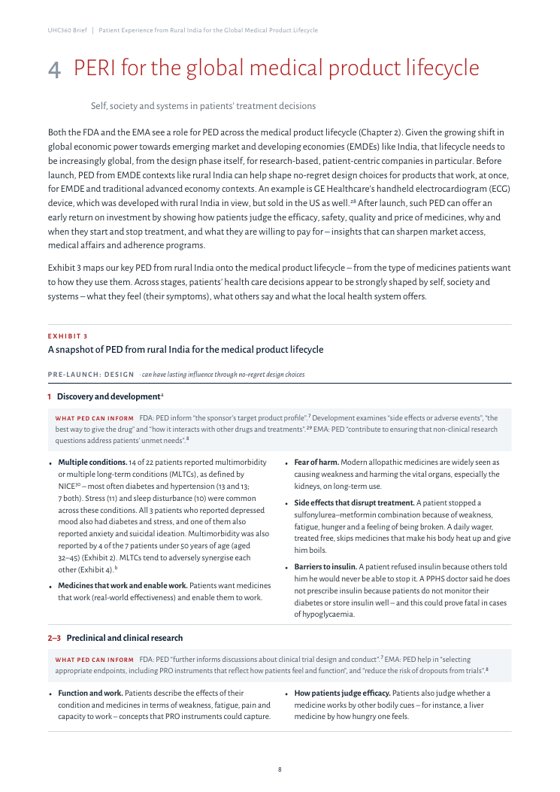
Exhibit 3 maps our key PED from rural India onto the medical product lifecycle – from the type of medicines patients want to how they use them. Across stages, patients’ health care decisions appear to be strongly shaped by self, society and systems – what they feel (their symptoms), what others say and what the local health system offers.
Exhibit 3
A snapshot of PED from rural India for the medical product lifecycle
Pre-launch: design · can have lasting influence through no-regret design choices
1Discovery and developmenta
What PED can inform
FDA: PED inform “the sponsor’s target product profile”.7 Development examines “side effects or adverse events”, “the best way to give the drug” and “how it interacts with other drugs and treatments”.29 EMA: PED “contribute to ensuring that non-clinical research questions address patients’ unmet needs”.8
- Multiple conditions. 14 of 22 patients reported multimorbidity or multiple long-term conditions (MLTCs), as defined by NICE30 – most often diabetes and hypertension (13 and 13; 7 both). Stress (11) and sleep disturbance (10) were common across these conditions. All 3 patients who reported depressed mood also had diabetes and stress, and one of them also reported anxiety and suicidal ideation. Multimorbidity was also reported by 4 of the 7 patients under 50 years of age (aged 32–45) (Exhibit 2). MLTCs tend to adversely synergise each other (Exhibit 4).b
- Medicines that work and enable work. Patients want medicines that work (real-world effectiveness) and enable them to work.
- Fear of harm. Modern allopathic medicines are widely seen as causing weakness and harming the vital organs, especially the kidneys, on long-term use.
- Side effects that disrupt treatment. A patient stopped a sulfonylurea–metformin combination because of weakness, fatigue, hunger and a feeling of being broken. A daily wager, treated free, skips medicines that make his body heat up and give him boils.
- Barriers to insulin. A patient refused insulin because others told him he would never be able to stop it. A PPHS doctor said he does not prescribe insulin because patients do not monitor their diabetes or store insulin well – and this could prove fatal in cases of hypoglycaemia.
2–3Preclinical and clinical research
What PED can inform
FDA: PED “further informs discussions about clinical trial design and conduct”.7 EMA: PED help in “selecting appropriate endpoints, including PRO instruments that reflect how patients feel and function”, and “reduce the risk of dropouts from trials”.8
- Function and work. Patients describe the effects of their condition and medicines in terms of weakness, fatigue, pain and capacity to work – concepts that PRO instruments could capture.
- How patients judge efficacy. Patients also judge whether a medicine works by other bodily cues – for instance, a liver medicine by how hungry one feels.
4Registration
What PED can inform
ICH E5: “Examples of extrinsic factors include the social and cultural aspects of a region such as medical practice, diet, use of tobacco, use of alcohol, exposure to pollution and sunshine, socioeconomic status, compliance with prescribed medications…”.21
Patients from rural India are “typically not part of randomized controlled trials”,31 so PERI cannot yet draw on rural trial participants’ experience. This makes PERI even more important, given how little trial data exist from rural India.
Post-launch: use · can offer an early return on investment for companies
5Launch and lifecycle management: routine care
What PED can inform
EMA: PED “contribute to treatment adherence” and can help “detect the causes of non-adherence”.8
- Traditional remedies first. Many patients prefer, and start treatment with, traditional remedies due to fear of adverse impacts from modern allopathic medicine – turning to it only when their condition worsens. One patient would not take it even if it were free.
- Symptomatic care. Almost all NCD patients, including the educated, treat NCDs symptomatically – they rely on how they feel (dizziness, for instance) rather than regular testing, take medicines when they feel unwell and discontinue them when they feel better.
- Discontinuation. A patient gave up his prescribed medications and lifestyle because the former were not seen as effective, while the latter made him feel weak.
- Weak sense of chronic care. Even an FHW, whose husband had high blood pressure, did not know that his medicines had to be taken continuously.
- NCD training and awareness. Lack of proper NCD training of FHWs and awareness among rural communities is the most fundamental challenge for the screening, prevention, treatment and management of NCDs.
- No follow-up. No one follows up with patients (FGDs with village communities), so how patients use, judge and stop medicines between visits is largely lost to the providers companies usually rely on for insight.c
- Brand continuity. Patients want exactly the brand their doctor prescribed (pharmacists). One patient, who takes free medicines from a PPHS facility, did not buy medicines in the open market during a month-long staff strike because he would not get the same brand.
5Launch and lifecycle management: access and affordability
What PED can inform
EMA: PED “support relative effectiveness assessments and economic evaluations” by HTA bodies.8
- Private care in nearby districts. Most NCD patients, including FHWs, turn to private care – often in nearby districts within and outside the state, which are sometimes closer than Rampur city. Patients and providers said that even semi-rural areas like Tanda, although prosperous, have very few qualified doctors and specialists.
- Cheap generics seen as “local”. Even poor patients see cheap generics offered by public facilities and pharmacies as “local” – low quality and ineffective – and many ask doctors not to prescribe them, even though “some generics are sometimes better than branded (ethical) medicines”, according to a government doctor. A Janaushadhi Kendra owner said it is difficult for him to make ends meet, and that most doctors do not prescribe generics and even tell patients not to buy them. Janaushadhi Kendra owners in Kerala and Karnataka report similar “quality–price misconceptions”.32
- Use of public health facilities. Some, including the better-off, trust and use public health care. They stop treatment or buy privately when public care is not available.
- Treatment as investment. Some poor patients are willing to invest up to 30% of their monthly income in medicines that work – and work extra hard to afford them – so that they can continue to work and earn.
- Treatment as top priority. A seasonal worker, who works extra hard to afford treatment, sometimes does not have money to buy flour after buying medicines.
- Proxy indicators of pockets of prosperity. There are massive household appliance shops in Tanda’s local market that keep high-end products like air-conditioners, automatic washing machines and even air fryers of various leading brands in big quantities (direct observation). They wouldn’t if there wasn’t a market for them. Some in Tanda villages spend up to USD / EUR 250,000 on a wedding. People in rural areas don’t like to keep or deposit cash in banks – they collect surplus money to buy land (village FGDs).
5Launch and lifecycle management: safety monitoring
What PED can inform
EMA: patients’ reports of suspected adverse drug reactions are “an important type of PED”. PED can “contribute to preventing medication errors”.8
- Self-treatment. An elderly lady takes her daughter-in-law’s medicines when she feels her blood glucose levels rising.
- Self-adjusted treatment. Patients stop taking medicines when they feel that they are causing side effects, or double their dose when they feel that they are not working as much as they should – without consulting their doctor.
- Unqualified advice and treatment. Many rely on community information – an FHW’s husband advised a diabetes patient to double his dose in front of us (direct observation). A pharmacist, without formal qualification, said he dispenses diabetes medicines on the basis of patients’ test results and adds medicines on his own to protect against what he believes is definite kidney and liver damage from long-term use.
- Over-the-counter use. Many buy medicines over the counter, without prescriptions (pharmacists). Prescriptions are not always on a doctor’s letterhead – we saw one on plain paper instead (direct observation).
AllDiagnostics and devices
What PED can inform
EMA: PED can help “establish the preferred medical device technology and technique”.8
- NCD detection. Patients visit doctors when symptoms become severe, and NCDs are detected through opportunistic screening.
- Monitoring conditions. Most patients don’t have monitoring devices at home, and often rely on “feelings” (symptoms) to get a sense of their blood glucose or blood pressure levels. They sometimes get their blood glucose or blood pressure levels tested at private or public facilities – but there are some who rarely get tested due to fear of needles and blood. Nevertheless, there is a willingness to have devices for home monitoring.d
Notes: Findings are from UHC360 field research in Rampur, UP, February–November 2026. Accounts from doctors and pharmacists are provider accounts rather than PED.
- a. Stages 1–3 as named by the FDA;33 stages 4–5 as named in leading companies’ pipeline reports and filings.34–38
- b. Multimorbidity “has notably started affecting younger age groups” in low- and middle-income countries,39 and the “exclusion or underrepresentation” of patients with multimorbidity “in clinical trials is well-documented”.40
- c. Patient experience is, therefore, best captured where patients live – especially in areas with few or no qualified providers – rather than in the clinics they visit intermittently.
- d. Nationally, only 17% of rural adults aged 30–69 had ever had their blood glucose measured, compared with 45% for blood pressure (2017–18).41 Further research is required to understand why blood glucose testing is substantially lower than blood pressure testing.
Diabetes-depression syndemic: A case study
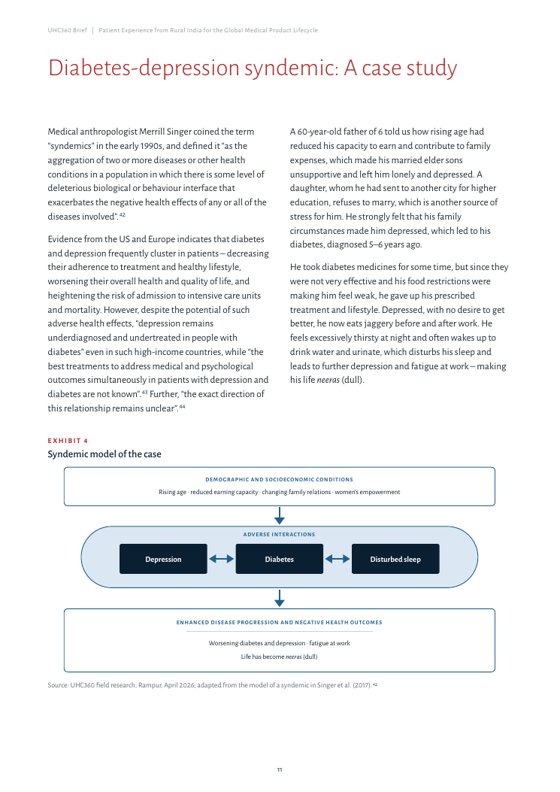
Medical anthropologist Merrill Singer coined the term “syndemics” in the early 1990s, and defined it “as the aggregation of two or more diseases or other health conditions in a population in which there is some level of deleterious biological or behaviour interface that exacerbates the negative health effects of any or all of the diseases involved”.42
Evidence from the US and Europe indicates that diabetes and depression frequently cluster in patients – decreasing their adherence to treatment and healthy lifestyle, worsening their overall health and quality of life, and heightening the risk of admission to intensive care units and mortality. However, despite the potential of such adverse health effects, “depression remains underdiagnosed and undertreated in people with diabetes” even in such high-income countries, while “the best treatments to address medical and psychological outcomes simultaneously in patients with depression and diabetes are not known”.43 Further, “the exact direction of this relationship remains unclear”.44
A 60-year-old father of 6 told us how rising age had reduced his capacity to earn and contribute to family expenses, which made his married elder sons unsupportive and left him lonely and depressed. A daughter, whom he had sent to another city for higher education, refuses to marry, which is another source of stress for him. He strongly felt that his family circumstances made him depressed, which led to his diabetes, diagnosed 5–6 years ago.
He took diabetes medicines for some time, but since they were not very effective and his food restrictions were making him feel weak, he gave up his prescribed treatment and lifestyle. Depressed, with no desire to get better, he now eats jaggery before and after work. He feels excessively thirsty at night and often wakes up to drink water and urinate, which disturbs his sleep and leads to further depression and fatigue at work – making his life neeras (dull).
Exhibit 4
Syndemic model of the case
Demographic and socioeconomic conditions
Rising age · reduced earning capacity · changing family relations · women’s empowerment
Adverse interactions
Enhanced disease progression and negative health outcomes
Worsening diabetes and depression · fatigue at work
Life has become neeras (dull)
Contextualising the findings
Our findings – and the case study in particular – are better understood within the demographic and socioeconomic context in which patients live and work.
Demographic and socioeconomic changes
India’s population is ageing rapidly – its elderly (60 years and above) population is estimated to be 218 million (15.4%) in 2026, and is projected to rise to 325 million (20.4%) by 2051.45 The man in our case study (Exhibit 4) linked his depression, diabetes and disturbed sleep to his changing demographic and socioeconomic conditions. He was not alone. For instance:
- A woman (over 60) said her 2 married sons do not care for her, and that her children say their parents have done nothing for them.
- A man (60), whose married children work and earn, but do not support him financially, works extra hard to afford his treatment and household expenses; after buying medicines, he said, there is no flour at home.
Our baseline evaluation found a similar pattern among FHWs: some over 70 continue to work because they feel that their children do not care for them, and “that they have to continue working to support themselves financially and be physically active to stay healthy”.23
Why women want to work
Our baseline evaluation of FHWs – all of them women – points to several reasons why women want to work in a predominantly patriarchal rural context:23
- Hope of empowerment. The hope of Nari Shakti (women’s empowerment) – and of better work status in the future – motivates them to continue working.
- Freedom. Working outside the home provides “freedom from the confines of the house, and from the domestic drudgery that comes with it”.
- Financial independence. Whatever little they earn offers “a degree of financial independence” – to spend on themselves or, often, on the education of their children or grandchildren. An FHW (57) continues to work so that she has some money of her own and can support her daughters and their families. Another FHW (32), who suffers from several health challenges, continues to work so that she can send her children to better schools.
- Respect. Contributing to household expenses raises their respect (izzat) within the family, and they are respected and sought after in the community for the health care support they provide.
- Peer support. Working with other FHWs gives them social support that helps them overcome personal challenges.
Paid work does not replace unpaid domestic work. The FHW (32), whose illness has substantially reduced her capacity to work, said her official work has to be completed, despite the fact that it affects her domestic work and ability to monitor her children’s education – and that she is not valued at home because she cannot attend properly to domestic work.
What this means for medicines
Medicines that work and enable people to work are, therefore, not just a concern of the male working-age population, but extend to a wider population across gender and age: older people who need to remain independent and active, and women who manage both paid and unpaid work. The FHW (32) said she wishes to get good treatment so that she can work well both at home and at work.
Economic hardship does not mean an absence of demand: even poor patients who could use free public care pay for private treatment out-of-pocket because they trust it works and enables them to work.
Future research
How UHC360 can help
UHC360 usually conducts quantitatively driven sequential mixed methods research – beginning with structured quantitative questions, followed by IDIs with patients and carers, and key informant interviews (KIIs) with public and private providers as well as other key experts and stakeholders. The health conditions that patients report during the interviews are coded to WHO’s ICD-11 to facilitate use by clinical teams. Our aim is to build rich patient narratives on NCDs and other health concerns, on multimorbidity, syndemics and the socioeconomic and demographic context in which patients make treatment decisions. Our IDIs build on each patient’s cluster of conditions and circumstances, captured through structured questions at the beginning.
How we work
- Structured questionsWe begin with structured quantitative questions that capture each patient’s cluster of conditions and circumstances.
- In-depth interviewsWe then interview patients and carers in depth, building on their answers to the structured questions.
- Key informant interviewsWe also interview public and private providers as well as other key experts and stakeholders.
- ICD-11 codingWe code the health conditions that patients report to WHO’s ICD-11, so that clinical teams can use them.
- Rich patient narrativesThe result: rich narratives on NCDs and other health concerns, multimorbidity, syndemics and the context in which patients make treatment decisions.
Although we do not run large surveys or generate extensive quantitative data ourselves, we are supporting the PPHS to collect robust population data on NCDs – and can help design or adapt instruments for quantitative studies as well as help analyse their findings based on our research. Exhibit 5 sets out what we can and cannot do at each stage of the lifecycle.
Exhibit 5
How we can contribute across the medical product lifecycle
Select a stage
1 · Discovery and development
What we can do
In-depth research on unmet needs, multimorbidity and syndemics; patient narratives to inform target profiles (TPPs) and no-regret design choices; research for devices and diagnostics
What we cannot do
Epidemiological surveys or disease-burden estimates – we can help design their questions and interpret their results
2–3 · Preclinical and clinical research
What we can do
Concept elicitation for COAs; attributes for patient preference studies; what tolerability and dropping mean to patients; cognitive interviews
What we cannot do
Trial operations, large preference surveys or psychometric validation – we can help design or adapt instruments and interpret findings
4 · Registration
What we can do
Context for benefit-risk assessment, such as the extrinsic factors in ICH E5; preparing for and joining meetings with regulators46
What we cannot do
Preparing regulatory submissions
5 · Launch and lifecycle management
What we can do
Why patients start (or not), stop or switch treatment; adherence; perceived quality, affordability and willingness to pay; how doctors, pharmacists, traditional practitioners and FHWs shape treatment decisions; uptake of screening and self-monitoring; patients’ accounts of side effects and self-adjusted treatment
What we cannot do
Large-scale real-world data collection or pharmacovigilance – we can help design patient-facing questions and interpret findings
All · Diagnostics and devices
What we can do
Patients’ needs and preferences for testing and monitoring
What we cannot do
Usability validation testing
Every engagement is led by Dr Ali Mehdi, who brings
21years of relevant experience
in13Indian states
and12countries of Asia, Africa, Europe and North America
This includes interviews with drug regulators, medical companies as well as other key experts and stakeholders in India, Europe and the US.
Examples of potential studies
In the light of our field research and findings so far, following are a few studies that could be helpful as far as PERI is concerned. However, we would be glad to conduct mixed methods or qualitative studies around a company’s own themes and research questions as well as tailor the study design, scope, sample size, etc. to its needs.
1Towards evidence-based careStages 1 and 5
How do self, society and systems – what patients feel, what people say and what providers offer – shape testing and treatment decisions of NCD patients? How can they be encouraged towards evidence-based decisions and care?
2Real-world effectiveness, safety and qualityStages 1 and 5
How do patients judge the real-world effectiveness, safety and quality of medical products? Which patient education strategies would work best in rural India to raise evidence-based awareness about their efficacy, safety and quality?
3Building a chronic care orientationStage 5
What could help build a chronic care orientation among rural patients, so that they view NCDs as long-term conditions that require continuous care and treatment adherence?
4Pricing and patient preference for public and private careStages 1 and 5
Context: The Government of India focuses on making medicines affordable through price control, supplying free medicines through public facilities and generics at very low prices through Janaushadhi Kendras.47 Its focus is on the supply side.
What we found: On the demand side, there is a general perception that government medicines are low quality and ineffective. Yet, while poor patients spend up to 30% of their monthly income on private treatment, some better-off patients trust and use government health facilities and medicines.
Why do some better-off patients trust and use free government health facilities and medicines, while poorer patients prefer and pay for private care – incurring catastrophic out-of-pocket health expenditure and working harder to afford it? How do patients’ socioeconomic circumstances shape their treatment preferences?
Select a study to see its main questions.
References
Show all 47 referencesHide references
- International Monetary Fund (2026). World Economic Outlook database, October 2026. https://www.imf.org/en/publications/sprolls/world-economic-outlook-databases
- Bain & Company and Confederation of Indian Industry (2022). Innovation in India’s Rural Economy. March 2022. https://www.bain.com/insights/innovation-in-indias-rural-economy/
- van Duijne R.J. (2026). What is the size of India’s domestic remittance flows? The India Forum, 6 February 2026. https://www.theindiaforum.in/economy/what-size-indias-domestic-remittance-flows
- World Bank. World Development Indicators (WDI), 2025: Population, total; Personal remittances, received (current US$). https://databank.worldbank.org/source/world-development-indicators
- Ministry of Health and Family Welfare (2020). Population Projections for India and States 2011–2036: Report of the Technical Group on Population Projections. National Commission on Population, July 2020. https://nhm.gov.in/New_Updates_2018/Report_Population_Projection_2019.pdf
- Office of the Registrar General and Census Commissioner, India (2026). Causes of Death Statistics 2022–2024. Sample Registration System. May 2026.
- US Food and Drug Administration (2026). Assessment of the Use of Patient Experience Data in Regulatory Decision-Making. Prepared by Booz Allen Hamilton. July 2026. https://www.fda.gov/media/194048/download
- European Medicines Agency (2025). Reflection paper on patient experience data (draft). EMA/CHMP/PRAC/148869/2025, 18 September 2025. https://www.ema.europa.eu/en/documents/scientific-guideline/reflection-paper-patient-experience-data_en.pdf
- US Food and Drug Administration (2022). Patient-Focused Drug Development: Methods to Identify What Is Important to Patients. Guidance 2, February 2022. https://www.fda.gov/media/131230/download
- UHC360 (2026). Field research in the Tanda region of Swar block and in Saidnagar block, Rampur district, Uttar Pradesh: semi-structured interviews with NCD patients, focus group discussions in villages and with primary health staff, and interactions with around 300 respondents in total since February 2026.
- Institute for Health Metrics and Evaluation (2025). Global Burden of Disease Study 2023 (GBD 2023). GBD Compare. https://vizhub.healthdata.org/gbd-compare/
- United Nations (2024). World Population Prospects 2024. https://population.un.org/wpp/
- Mukherji A., Rao M., Desai S., Subramanian S.V., Kang G., Patel V. (2024). District-level monitoring of universal health coverage, India. Bulletin of the World Health Organization 102: 630–638B. https://doi.org/10.2471/BLT.23.290854
- International Institute for Population Sciences and ICF. National Family Health Survey (NFHS-5), 2019–21: Uttar Pradesh. https://dhsprogram.com/pubs/pdf/FR374/FR374_UTTARPRADESH.pdf
- National Health Systems Resource Centre, Ministry of Health and Family Welfare (2026). National Health Accounts Estimates for India 2022–23. https://nhsrcindia.org/sites/default/files/2026-05/NHA%202022-23%20Report.pdf
- US Food and Drug Administration (2017). Plan for Issuance of Patient-Focused Drug Development Guidance under 21st Century Cures Act Title III Section 3002. May 2017. https://www.fda.gov/media/105979/download
- US Food and Drug Administration. Patient-Focused Drug Development meetings. Accessed 26 October 2026. https://www.fda.gov/media/160223/download
- 21st Century Cures Act (2016). Public Law 114-255, Sections 3001–3002. https://www.govinfo.gov/content/pkg/PLAW-114publ255/html/PLAW-114publ255.htm
- US Food and Drug Administration (2020–2025). Patient-Focused Drug Development guidance series, Guidances 1–4. https://www.fda.gov/drugs/development-approval-process-drugs/fda-patient-focused-drug-development-guidance-series-enhancing-incorporation-patients-voice-medical
- International Council for Harmonisation (2025). E22 General Considerations for Patient Preference Studies. Step 2 draft, endorsed 19 November 2025. https://ich.org/page/public-consultations
- International Council for Harmonisation (1998). E5 Ethnic Factors in the Acceptability of Foreign Clinical Data. https://database.ich.org/sites/default/files/E5_R1__Guideline.pdf
- Economics and Statistics Division, State Planning Institute, Planning Department, Uttar Pradesh (2024). District Wise Development Indicators: Uttar Pradesh 2024. https://updes.up.nic.in/updes/data/dist_dev_indicator/dist_dev_indicators_2024.pdf
- UHC360 (2026). ASHA Readiness Assessment for Comprehensive Primary Health Care in Uttar Pradesh, India: A baseline evaluation of CBAC data collection in Rampur. August 2026.
- World Health Organization (2025). International Classification of Diseases, 11th Revision (ICD-11) for Mortality and Morbidity Statistics. https://icd.who.int/browse/2025-01/mms/en
- World Health Organization (2024). The World Health Organization-Five Well-Being Index (WHO-5). https://cdn.who.int/media/docs/default-source/mental-health/who-5_english-original4da539d6ed4b49389e3afe47cda2326a.pdf
- World Health Organization. World Health Survey Plus: Individual Questionnaire. Sections 6000 (Social Networks) and 7000 (Quality of Life and Subjective Wellbeing). https://www.who.int/data/data-collection-tools/world-health-survey-plus
- Hong Kong Family Welfare Society. Hong Kong Family Wellbeing Index. https://www.hkfws.org.hk/en/hkfwi
- Immelt J.R., Govindarajan V., Trimble C. (2009). How GE is disrupting itself. Harvard Business Review, October 2009. https://hbr.org/2009/10/how-ge-is-disrupting-itself
- US Food and Drug Administration. Step 1: Discovery and Development. https://www.fda.gov/patients/drug-development-process/step-1-discovery-and-development
- National Institute for Health and Care Excellence (2016). Multimorbidity: clinical assessment and management (NG56). https://www.nice.org.uk/guidance/ng56
- Raju P. (2025). India is Incomplete Without Bharat: Experts Push for Rural Inclusion in Clinical Trials. ETPharma, The Economic Times, 4 June 2025. https://pharma.economictimes.indiatimes.com/news/pharma-industry/bridging-indias-urban-rural-divide-in-clinical-research/121625537
- Aboobaker N., Priya R. (2026). Beyond Affordability: Trust, Sustainability, and the Lived Experiences of Jan Aushadhi Kendra Owners. International Journal of Latest Technology in Engineering, Management & Applied Science 15(1): 474–479. https://doi.org/10.51583/IJLTEMAS.2026.150100042
- US Food and Drug Administration (2018). The Drug Development Process. Content current as of 4 January 2018. https://www.fda.gov/patients/learn-about-drug-and-device-approvals/drug-development-process
- AstraZeneca (2026). AstraZeneca Development Pipeline as at 10 February 2026. Clinical trials appendix, FY and Q4 2025 results. https://www.astrazeneca.com/investor-relations.html
- Novartis. Novartis Pipeline. Accessed 21 October 2026. https://www.novartis.com/research-development/novartis-pipeline
- Pfizer Inc. (2025). Annual Report on Form 10-K for the fiscal year ended 31 December 2024. https://www.sec.gov/Archives/edgar/data/78003/000007800325000054/pfe-20241231.htm
- Roche (2026). Roche Group development pipeline: Q2 2026 update. Status as of 23 July 2026. https://assets.roche.com/f/176343/x/cb875526bd/pharmahy26.pdf
- Sanofi. Our Product Pipeline. Accessed 21 October 2026. https://www.sanofi.com/en/science-and-innovation/research-and-development/rd-pipeline
- Gupta P., Prabhakaran D., Mohan S. (2022). Multimorbidity or multiple long-term conditions: need for bridging the evidence & care gaps to address an emerging priority public health issue in India. Indian Journal of Medical Research 156(3): 381–383. https://doi.org/10.4103/ijmr.ijmr_1822_21
- González-González A.I. et al. (2026). Rethinking clinical trials in the multimorbidity era: the imperative for patient-centered tailored approaches. Journal of Clinical Epidemiology 194: 112204. https://doi.org/10.1016/j.jclinepi.2026.112204
- ICMR-National Centre for Disease Informatics and Research (2020). National Noncommunicable Disease Monitoring Survey (NNMS) 2017–18. Bengaluru, India.
- Singer M., Bulled N., Ostrach B., Mendenhall E. (2017). Syndemics and the biosocial conception of health. Lancet 389: 941–950. https://doi.org/10.1016/S0140-6736(17)30003-X
- Petrak F., Baumeister H., Skinner T.C., Brown A., Holt R.I.G. (2015). Depression and diabetes: treatment and health-care delivery. Lancet Diabetes & Endocrinology 3(6): 472–484. https://doi.org/10.1016/S2213-8587(15)00045-5
- Roy T., Lloyd C.E. (2012). Epidemiology of depression and diabetes: a systematic review. Journal of Affective Disorders 142 (Suppl): S8–S21. https://doi.org/10.1016/S0165-0327(12)70004-6
- Rajan S.I., Retnakumar J. (2026). Population Crossovers and India’s Ageing Dynamics. Economic and Political Weekly 61(9), 28 February 2026. https://doi.org/10.71279/epw.v61i9.48519
- Mehdi A., Mongia R., Pokhriyal D., Rao S. (2017). Challenges and Prospects for Clinical Trials in India: A Regulatory Perspective. Academic Foundation, New Delhi. https://icrier.org/publications/challenges-and-prospects-for-clinical-trials-in-india-a-regulatory-perspective-2/
- Department of Pharmaceuticals, Government of India. Janaushadhi Scheme: Pradhan Mantri Bhartiya Janaushadhi Pariyojana (PMBJP). https://pharma-dept.gov.in/janaushadhi-scheme